
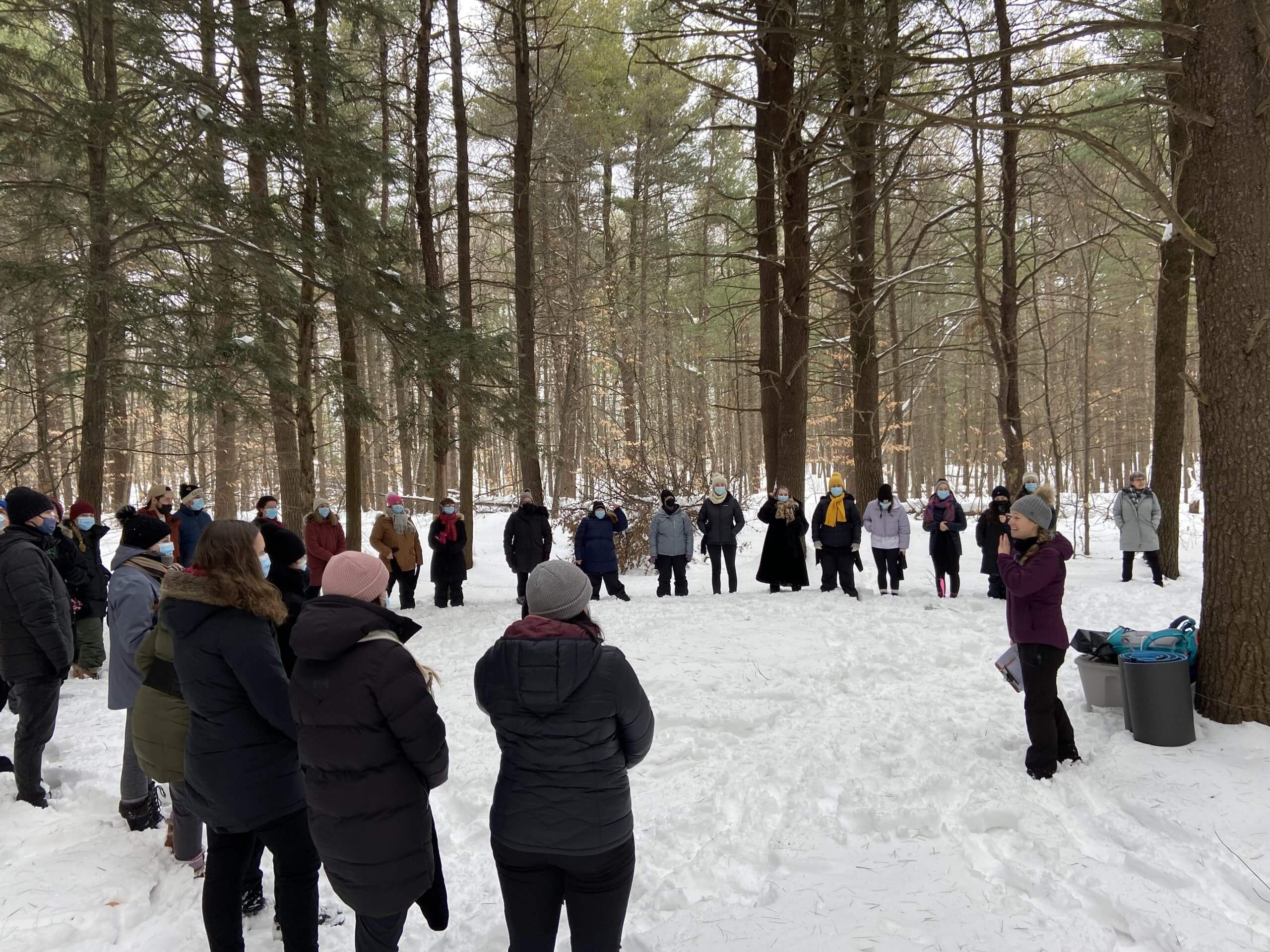
Geneviève Bergeron and Mathieu Point are the co-holders of the chair.
Since the beginning of autumn, the co-owners of the new Chair Excellence in Teaching “Education through nature and learning area” welcoming primary school students on campus for nature education activities. Guided by different actors from UQTR, or partners from different communities, old colleagues do not only teach outside. They invite students to develop varied skills and knowledge, and to awaken their sensitivity and their attachment to the places around them in order to preserve them.
“We should not confuse outdoor lessons with education through nature. Instead of simply having students sit outside to take lessons like French and maths, we anchor education in the land, which becomes an entity we can relate to. This territory becomes an immersive and inspiring learning space where emotions and sensations are called for. This approach has many advantages for intellectual, emotional and physical development,” explains Professor Mathieu Point.
“The educational and didactic potential of forests is enormous, both for primary school pupils and for our university students,” adds Professor Geneviève Bergeron. “Forest areas can be the subject of a great many historical, geographical, ethical, sociological, cultural questions, etc. The lived experience encourages pupils to bring different disciplines into dialogue, which allows for a more holistic understanding of the world around us. This is increasingly important if we want to reflect on the complex problems we face on an environmental and social level. For us, education through nature is a vector of social change.”
An open-air laboratory
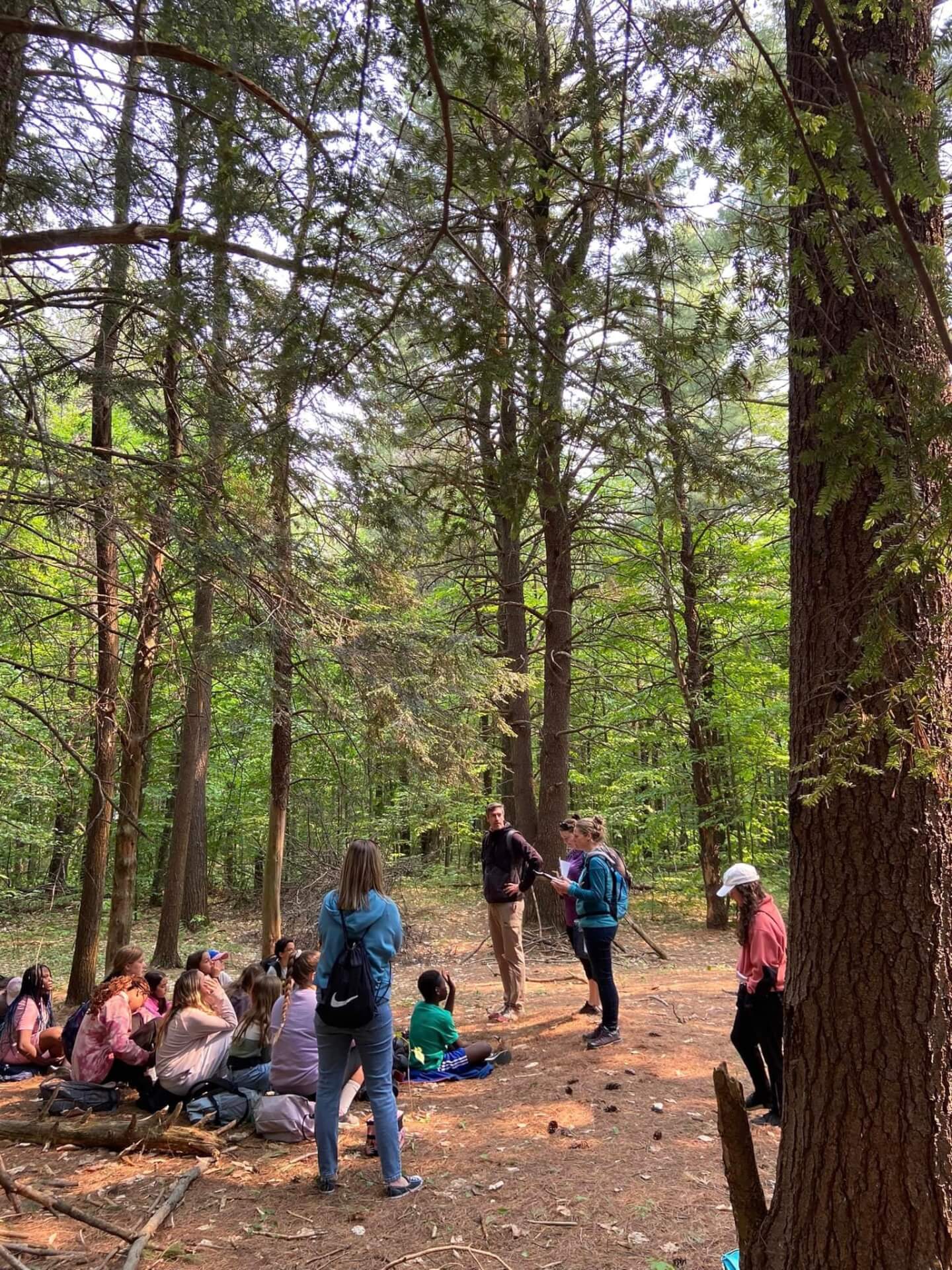
With its rich and spacious natural environment, the UQTR campus functions as an open-air laboratory.
With its rich and spacious natural environment that connects to the ecological area of the Milette river, the UQTR campus serves as an open-air laboratory. There are numerous opportunities to develop projects that bring together different Mauricie communities. Indeed, the idea of creating social ties is at the heart of their project. As part of the work of their chair, Mathieu Point and Geneviève Bergeron will work on creating the conditions necessary for the development of a learning area and the implementation of the concept of education through nature as an innovative training niche, from nursery school to nursery school University. A map of cultural, social, historical and natural knowledge on campus will also be created in order to identify all the resources that can be highlighted and protected as part of nature education activities on campus.
To achieve this, training activities on education through nature will be offered to UQTR students and professors from different disciplines interested in this concept. Collaborations have already been established with certain departments, among others Environmental sciences like leisure, culture and tourism.
The work of the Chair of Excellence in Teaching “Education through nature and learning territory” will therefore make it possible to make the UQTR campus a more open and accessible educational and awareness-raising environment for the community. The Piliers Verts organisation, the Trois-Rivières Primary School of International Education, the Richelieu School and the Bel-Avenir Training Centre are the first in a long list of partners with whom the researchers are collaborating and will collaborate.
 Furthermore, the snowflakes and the cold do not slow down the activities of the chair in any way while the external work continues. From kindergarten to university, stakeholders who want to benefit from the activities of the chair can contact the team by consulting their website www.uqtr.ca/ena-terra.

Information and interview coordination
Jean-François Hinse – Communications Advisor
Media Relations Manager
Department of Communications and Alumni Relations – UQTR
Cell. : 819 244-4119
Email: jean-francois.hinse@uqtr.ca