
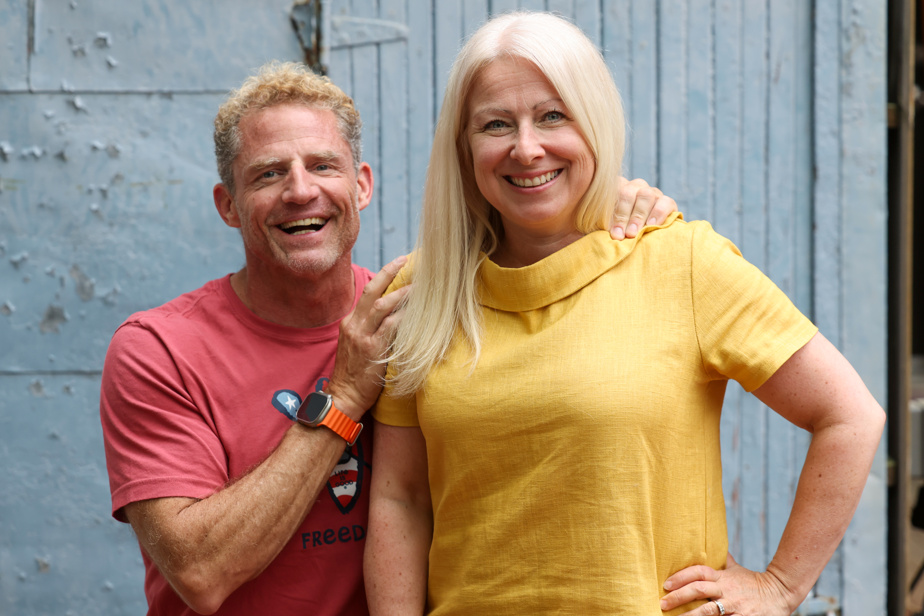
Healthcare systems are crumbling under the weight of chronic diseases (diabetes, cardiovascular disease, stroke, etc.). However, 80% of the most common chronic diseases could be prevented by simply changing our lifestyle. How ? That’s what pediatrician and researcher Julie St-Pierre and her sidekick Jean-Marie Lapointe wanted to know.
The duo will launch the documentary this week Why wait? Health within reach, the result of a quest that took them to five countries, where they were confronted with eminent researchers and personalities committed to global and sustainable health. Francesco Branca, of the World Health Organization (WHO); neuropsychiatrist Boris Cyrulnik; triathlete Pierre Lavoie; astronaut David Saint-Jacques; the Buddhist monk Matthieu Ricard: the spectrum is broad.
The documentary was launched on May 28 at Montreal’s Jean-Eudes College and will be available to the public for free on the Cardiovascular Health Action Network website from May 31 to June 2. It is then linked to the Chair in interdisciplinary education for a healthy lifestyle, also launched this week. The plan is to also present it at documentary film festivals.
“There are spicy documentary films in the United States Super size me. We’re not there. Our film is not advertised: it is a ‘little train goes far’ film,” illustrates actor and author Jean-Marie Lapointe. “We want it to be a clear documentary, full of solutions,” adds DD St-Pierre, for whom television broadcasts are not a priority.
The film consists of a series of interviews with experts from here and elsewhere, from whom the two interviewers wanted to extract “the elixir”, the pieces of the puzzle. Is adopting a healthy lifestyle an individual or collective responsibility? “Both,” answers Julie St-Pierre. It is individual, she says, provided the person is informed and the options are accessible to them.
Their search first leads them to Professor Robert Lustig, enemy of junk food in the United States. He explains to them how ultra-processed foods – high in sugar and low in fiber – cause inflammation and damage gut and metabolic health, which we now know are “inseparable.” The duo was also able to complete the DR Francesco Branca, Director of the WHO Department of Nutrition and Food Safety, to talk about strategies that work: tackling digital marketing in the agri-food industry; taxing sugary drinks (cheaper than water in certain regions!), subsidizing the purchase of healthy food.
Julie St-Pierre and Jean-Marie Lapointe went to Denmark to visit Herlev Hospital, which serves healthy meals to patients while saving money. A short visit also to Copenhagen, the capital, designed to encourage physical activity, with its cycle paths, its access to water, its public banks… The DD St-Pierre draws a parallel with the outrage of motorists who feel threatened by Montreal’s new bike lanes.
When we see what is happening in other parts of the world, we understand the beneficial effects of these measures on the health of the population.
The dR Julie St-Pierre
According to the Danish government, for every kilometer traveled by bicycle, society receives 0.8 euros in socio-economic benefits.
Julie St-Pierre and Jean-Marie Lapointe also discussed childhood with the neuropsychiatrist Boris Cyrulnik, and altruism with the Buddhist monk Matthieu Ricard, a geneticist by training, with supporting studies (an idea by Jean-Marie Lapointe, which the DD St-Pierre welcomed it as a “gift”).
-

IMAGE FROM THE DOCUMENTARY WHY WAIT?
“Eat real food. Real food comes from the ground, or from animals that get food from the ground. » — Robert H. Lustig, professor emeritus of pediatrics at the University of California, San Francisco
-

IMAGE FROM THE DOCUMENTARY WHY WAIT?
“You don’t choose to have cancer. On the other hand, we will treat the person who has cancer with empathy. And we ? We don’t have the right? » — Anne-Sophie Joly, president of the National Collective of Obesity Associations
-

IMAGE FROM THE DOCUMENTARY WHY WAIT?
“What interests me is sport at a low level. The bad football team, the football team. The bad jazz orchestra, with the boys and girls from the neighborhood partying in the village. » — Neuropsychiatrist Boris Cyrulnik
-

IMAGE FROM THE DOCUMENTARY WHY WAIT?
“We have environments where foods high in fat, sugar and salt, and therefore highly processed, are offered to people, especially children, who cannot defend themselves. » — Francesco Branca, WHO
-

IMAGE FROM THE DOCUMENTARY WHY WAIT?
“We know that people who practice kindness and volunteerism, who dedicate themselves to others, who have extremely rich human relationships, tend to have a longer life expectancy. » — Matthieu Ricard, geneticist turned Buddhist monk
-

IMAGE FROM THE DOCUMENTARY WHY WAIT?
“I dream of changing my physical activity model. That every young person can develop in a favorable, non-toxic environment. » — Triathlete Pierre Lavoie
-

IMAGE FROM THE DOCUMENTARY WHY WAIT?
“When we say the importance of the seven generations, it is to honor the seven generations that preceded us, and to think of the seven generations that will follow us. » —Thérèse Niquay, from the Atikamekw people of Manawan
-

IMAGE FROM THE DOCUMENTARY WHY WAIT?
“By walking and cycling we experience our city in a way that is different, that is nourishing. ” – The dD Véronique Morin, general practitioner specialized in prevention
1/8
The search had a personal dimension, both for the DD St-Pierre, whose parents both suffered heart attacks when she was a teenager, and Jean-Marie Lapointe, who was once obese and suffered from an eating disorder.
Changing the way you eat also means you risk falling into the trap of dieting, obsession and control. How to find balance? According to the DD St-Pierre, the key is to intervene early, both to prevent eating disorders and to establish good lifestyle habits. The team also visited the Étincelle School, a new laboratory school in Saguenay, where children attend cooking workshops and train in the acoustic gymnasium or on the beautiful schoolyard.
Isn’t preventing 80% of chronic diseases a utopian goal? “It’s true that it’s utopian,” agrees Julie St-Pierre, “but if we don’t believe in it, if we don’t try, we’ll just keep dying out. »
Visit the Cardiovascular Health Action Network website