
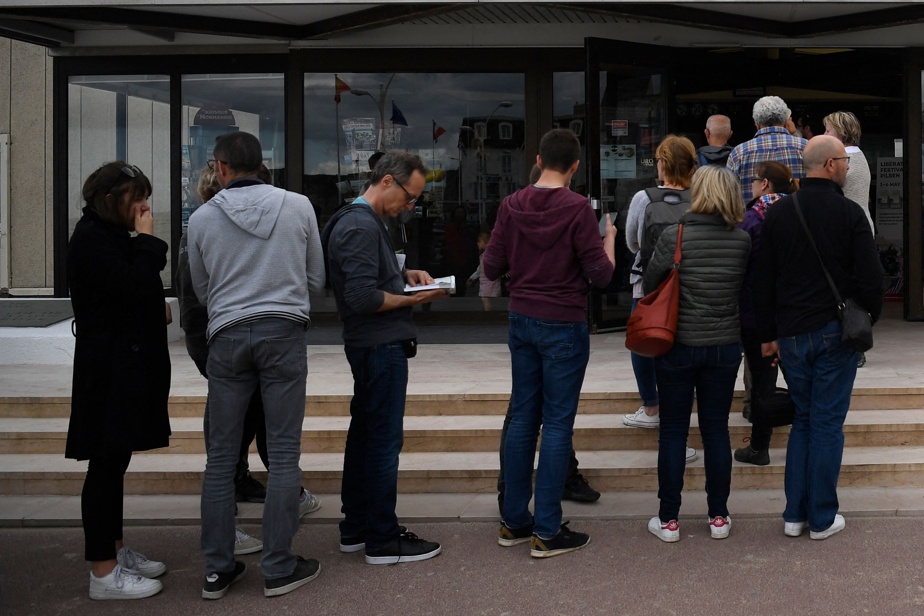
(Arromanches-les-Bains) By jeep, bicycle or even kayak: to discover the D-Day beaches on the west coast of France, there is no shortage of tourists who came to Normandy on the occasion of the 80th anniversary of D-Day . Day of your choice.
With 94 locations dedicated to the Battle of Normandy, the offer continues to diversify and innovate to convey this page of history in a different way, in light of the gradual disappearance of the last veterans.
“I really thought so cool to kayak around the man-made harbour,” set up by the Allies, says Brooke Bement, 20, in front of the imposing Landing Museum in Arromanches, overlooking the sea.
“Soon there will be nothing left!” », said his little brother Corban, ten years old, happy to have discovered the Phoenix caissons, elements of the dike, before they disappeared into the sand.
In the museum, completely renovated last year, these Americans discover the port as it functioned in the summer of 1944 thanks to video cards on a 25-meter model2.
This first museum about the Landing, which opened in 1954 and would contain elements of the permanent exhibition presented in the town hall just after the war, was planned for 35,000 “pilgrims”.
In 40 years, the number of visitors has continued to grow and the milestone of 300,000 visitors was exceeded in 1975. The year 1984 marks a turning point with the internationalization of commemorations, Arromanches welcomes the Queen of England and thousands of veterans.
From the early 1990s to today, memory tourism has taken off: sites are multiplying and the number of visits continues to grow.
“Many of museums”
This audience, on average 53 years old, includes 58% French, according to a study published by the Normandy region. Foreigners mainly come from the Netherlands, followed by Belgium, Great Britain/Ireland, Germany and the United States.
Topping the visit list are Utah and Omaha beaches, with locations that have suffered heavy inland fighting being the least visited.
To meet the new expectations of visitors and reach the youngest, Normandy, France’s leading region in memory tourism, has increased public and private investments. For 16 sites, the envelope represents approximately 80 million euros from 2012 to 2022.
Dutchman Ted Koks first came to the Pointe du Hoc 40 years ago when “there was a path and cows between the log cabins”. Today, a large parking lot and a visitor center receive visitors in an area protected by barriers.
Museums in Utah or Juno Beach are becoming increasingly modern, others are emerging with specific themes such as the memorial to civilian victims in Falaise, inland.
“We have a multitude of museums that are more complementary than our competitors. That makes the destination strong,” estimates Frédéric Sommier, director of the Arromanches museum, which plans to welcome around 350,000 visitors this year to this village of 500 inhabitants where businesses linked to D-Day are flourishing.
“D-Day country”
As proof of the dynamism of this sector, whose turnover exceeds 25 million euros and employs 8,410 direct and indirect jobs, new projects are emerging… sometimes controversial.
The latter concerns “a great compelling show”. Nicknamed “D-Day Land” by opponents, they view it as an amusement park encroaching on agricultural land.
Despite these criticisms, this private project, called Normandy Memory and which aims to be historically rigorous, should finally see the light of day in 2026 or 2027 on an industrial wasteland near Caen.
“Memory tourism is not normal tourism,” concludes Nathalie Porte, vice-president of the Normandy region, responsible for tourism. It is a very specific tourism with a truly respectful eye for history and also for the environment. »