
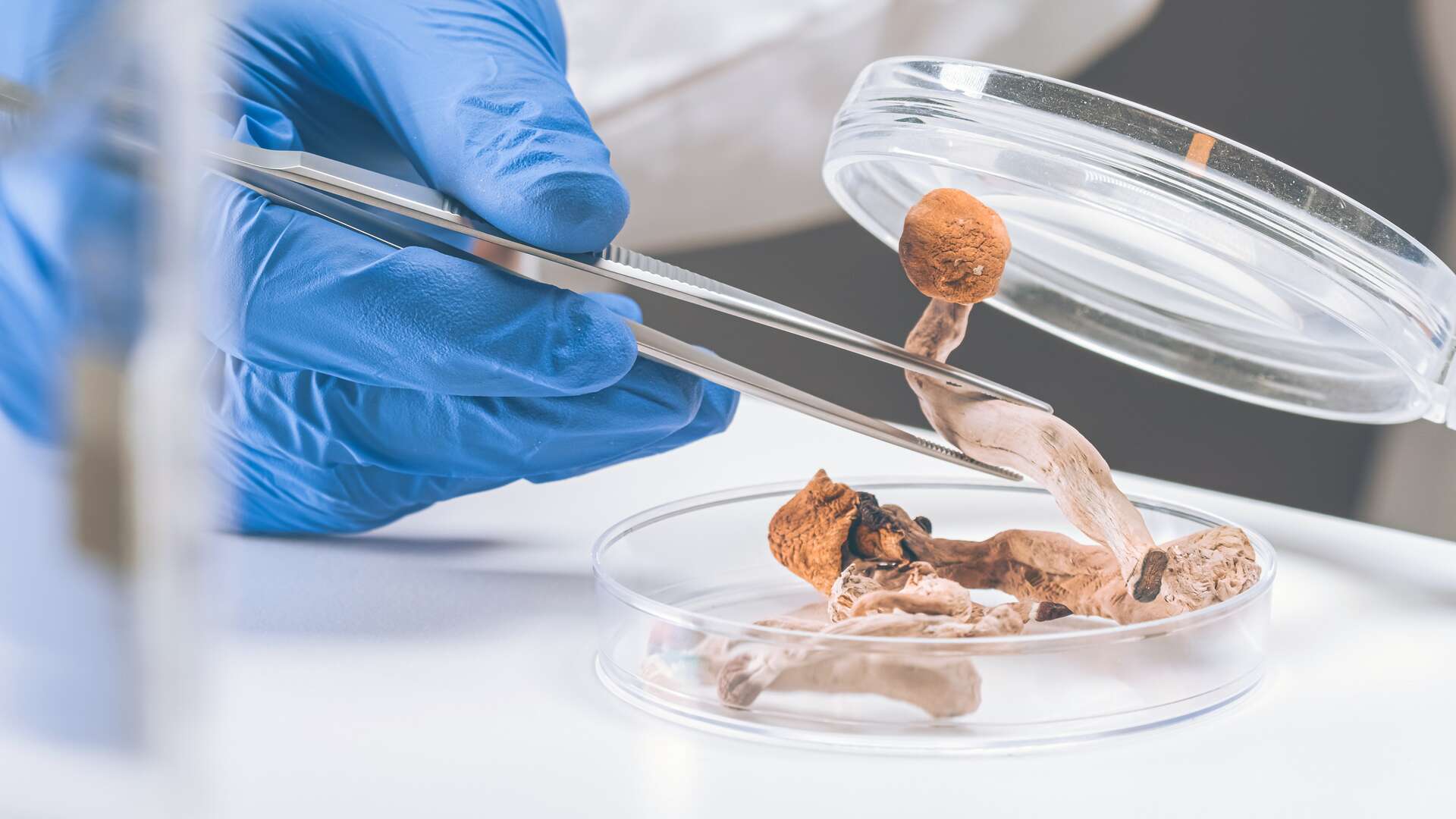
Stopping the scourge of alcohol addiction with the help of psychedelics: here’s a promising scientific breakthrough. A new study proposes using the active compound of hallucinogenic mushrooms, psilocybin, to treat alcohol addiction, also lifting the veil on the mechanisms of action of this molecule, which was previously unknown.
This study was conducted by Professor Mickael Naassila and his team from the Alcohol and Drug Dependence Research Group (Grap, UPJV/INSERM 1247 laboratory). The results, published in the scientific journal Brain, show that the administration of psilocybin, in mouse modelsmouse models of addictionalcoholalcoholhalved their alcohol consumption.
An unexpected cerebral lateralization
To explain these effects and better understand the underlying mechanisms, the researchers measured the expression of certain genes in the nucleus accumbens that are known to be involved in alcohol addiction. The nucleus accumbens is a brain region that plays a central role in addiction, specifically by communicating the pleasurable effects of drugs and the motivation to use them. The results of the study surprisingly reveal a cerebral lateralization of the effects of psilocybin, with a modification of the expression of certain genes, up or down, differently depending on the side of the brain. brainbrain. These initial results therefore led researchers to investigate the specific role of the left or right nucleus accumbens by injecting psilocybin directly into the side of the relevant nucleus.
Psilocybin reduces alcohol self-administration
Psilocybin injected into non-alcohol consuming rats causes specific changes in the brain, including a decrease in the expression of brain 5HT-2A receptors. serotoninserotonin only in the left nucleus accumbens. Unexpectedly, the increase in the expression of the BDNF gene was associated with plasticity of the brainplasticity of the brain, was only observed in the right nucleus accumbens. When psilocybin is injected directly into the left nucleus accumbens, alcohol consumption is halved, but it has no effect when injected into the right nucleus accumbens.
The study by Professor Naassila’s team then went even further to decipher the biological mechanism of psilocybin. We know that the hallucinogenic effects of psilocybin are related to its action on the 5-HT2A serotonin receptors. In this work, the researchers showed that these receptors were overexpressed after treatment with psilocybin. They then tested the effect of blocking these receptors, to really show that the effects of psilocybin on alcohol consumption are related to a specific effect on the 5-HT2A serotonin receptors. And indeed, theinfusioninfusion ketanserin, a 5HT-2A receptor blocker, directly in the left nucleus accumbens, prevents psilocybin from reducing alcohol consumption. This blockade in the right nucleus accumbens is ineffective.
Alcohol destroys dopamine receptors…
The study also highlights lightlight another known potential mechanism in addiction. Psilocybin administration increases the expression of dopamine D2 receptors in the nucleus accumbens in alcohol-consuming rats. Since we already know that alcohol addiction involves a reduction in the expression of D2 receptors in animals and humans, these results could also explain how psilocybin counteracts the mechanisms of addiction by restoring the expression of these receptors.
This unprecedented discovery about the lateralization of the effects of psychedelics in the treatment of alcohol addiction opens new avenues for research. Next steps: map this lateralization more precisely and check whether it generalizes to other psychedelics (LSD, DMTDMT…)). According to Professor Mickael Naassila: “ These results are very original because they show that psilocybin affects gene expression differently depending on the hemisphere. And that in the brain it is mainly the nucleus accumbens, located in the left hemisphere, that appears to be involved in the effects of reducing alcohol consumption “.